
Want to know if your punching machine score is average—or elite? This quick primer explains how scores work on standard 0–999 machines, what typically counts as good, excellent, and near-cap, and why calibration differences between venues can change your number. Below you’ll find a clear score chart, real-world ranges by player type, and simple technique cues to climb into the next tier.
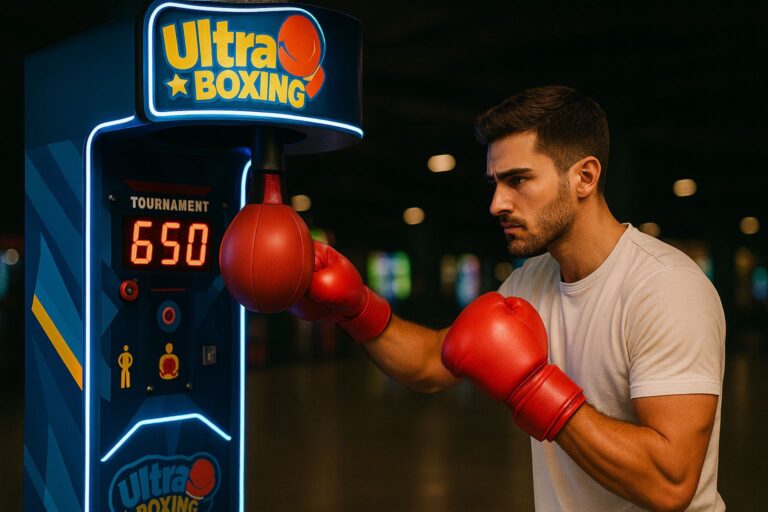
What's the average score on a punching machine?
First, let’s look at the punching machine score chart:
| Player Category | Avg. Score Range | Notes & Context |
|---|---|---|
| Children (under 12) | 150–300 | Lower body mass and speed; more sensitive to machine tuning. |
| Teenagers (13–17) | 300–500 | Strength rising; distribution more spread out. |
| Adult Beginners (No Training) | 400–650 | Where most casual players truly sit. |
| Recreational Athletes (Gym-goers) | 600–750 | Better conditioning and mechanics; consistently above average. |
| Trained Fighters (Boxing/MMA) | 750–900+ | Sound technique and kinetic chain; more accurate impact. |
| Elite / Professional | 900–999 | Near/at the cap on 0–999 machines; higher scores require expanded-range models. |
Note: A small number of models or specific settings display 1000+ due to different range or calibration. These aren’t directly comparable with 0–999 machines.
Where do the punching machine score chart come from?
Player measurements. To obtain an accurate average score on a punching machine, we asked several clients for help—huge thanks to them. They recorded many hitters’ ages, training status, and raw scores, giving us very real-world data.

Why you can trust the punching machine score chart
To ensure these “average ranges” are trustworthy, we built the answer on three verifiable layers:
Manufacturer manuals (e.g., LeYou/Kalkomat). Mainstream machines clearly use 0–999 scoring and allow sensitivity/difficulty and max-score adjustments in the service menu. This explains venue-to-venue score shifts.
LeYou install-base data. Over the last 12 months (standard settings; maintenance periods and anomalies removed; 10,000+ valid punches), untrained adults cluster at 400–650; 800+ is rare; 900–999 is near the ceiling.
Client-contributed logs. Numerous raw logs like the examples above mirror the ranges in the table.
Based on these three checks, we report ranges on the same machine/with the same settings only, so the averages you see are reliable and reproducible in real scenarios.
So, what’s the average score? On standard 0–999 machines, our 12-month LeYou dataset (10,000+ punches, standard settings) shows casual adults cluster around 400–650. Scores near 700 are above average, 800+ are uncommon (usually fast, well-timed punches), and 900–999 is the cap range. Because operators can adjust sensitivity, compare your progress on the same machine.
Why Your Punching Machine Scores Vary: 4 Factors That Change
Even with the same hands, scores often change from one machine to another. The main reasons:
Machine Calibration & Resistance (the biggest variable)
Different brands/models have adjustable back-end settings. Most boxing machines include a settings menu to change sensitivity/difficulty, reset highs, or even alter the score ceiling or ball tension. Operators in bars/arcades tune them for the scene, which is why scores can swing across venues.
Resistance and mechanisms can be adjusted or wear out. Ball/spring tension, return speed, and internal damping change; the same impact signal going into the algorithm will differ as a result.
Sensor Technology: Strain gauge vs. spring/pressure-based
Different sensor types → different reading styles. Modern machines commonly use strain gauges/load cells, piezo/pressure pads, or accelerometer combos. They convert deformation or speed change into an electrical signal, which is then scored. Electronics, sampling rate, and mounting position all influence how the same punch is recorded.
Maintenance has a direct impact. Misaligned sensors or drifted sensitivity can cause “same effort, lower score” or even missed reads—service adjustments often fix low/zero-score issues.
The Scoring Algorithm (it’s not just “force”)
The number behaves more like impulse. Machines typically reward short-time, high-velocity, centered contact—a fast, crisp, square shot spikes the signal; a slow “push,” even if strong, can under-score. In physics: impulse = force × time = change in momentum.
Hit location acts like a multiplier. Striking the “sweet spot” (centered, optimal rebound) yields higher peak/rate-of-change readings; off-center or glancing shots drop points. Many manufacturer notes emphasize that aim and timing influence scoring.
Operator Error (you can “beat yourself”)
Common pitfalls:
Pushing instead of whipping (insufficient speed)
Standing too close or too far; non-linear strike path
Collapsed wrist; arm-only punching without hip/shoulder rotation
Waiting too long as the ball’s return speed drops
Off-center or side contact
All of these weaken the impact signal the sensor reads, and scores fall.
One-line summary: Your score = (how the machine is tuned and maintained) × (sensor type) × (what the algorithm rewards) × (how fast and clean you strike). Cross-machine comparisons mean little—track your trend on the same unit.
What's a good score for punching machines?
On common 0–999 models, holding around 700 counts as good (better than most players); 800+ is an excellent minority; 900–999 is near the limit. This threshold comes from LeYou’s last-12-month standard-settings sample: overall median ≈ 505, P75 ≈ 680, P90 ≈ 790. Crossing ~700 roughly puts you in the top 25%. In real data, 800+ = 6.2%, 900+ = 0.8%. Because machines vary across venues, it’s best to compare only against your own scores on the same unit.
How to get a high score on a punch machine?
To sit steadily at 750+ and push 850+, it’s not brute force—it’s the combo of faster, cleaner, whole-body punching. Research and coaching practice point the same way: speed and coordination (kinetic chain) determine how much of your strength you actually deliver.
Technique Over Strength (get it right, then add power)
Stance: Staggered feet, toes slightly out; stable yet ready to drive. Rear heel lightly raised for rotation and a solid “push from the floor.”
Sequence: Foot → knee → hip → trunk → shoulder → elbow → fist—a whip-like chain, not an arm push. This transfer chain is widely supported in kinematics research.
Strike path: Straight line, elbow in, shoulder guarding; aim for peak hand speed at contact, not after full lockout.
Hit the sweet spot: Centered, not glancing. Many machines read peak/rate-change; off-center hits cost points.
Bottom line: Correct mechanics let you deliver the strength you already have. Many strong people score average because their sequencing is off.
Engage Your Whole Body (not just the arm)
Borrow from the ground: Small dip then drive; rear-foot push triggers hip/shoulder rotation.
Core as the driveshaft: A stable core transmits lower-body force cleanly to the upper body; instability “leaks” power.
Effective mass: Don’t body-check the bag; coordinate segments so more usable mass arrives at impact—often called effective mass, strongly tied to output.
Practice ideas: slow-motion linked punches (feel foot-hip-shoulder order), rotational medicine-ball slams/throws, short-range acceleration punches.
Speed Is King (why a “fast whip” beats a “hard push”)
Plain-English physics: The machine “likes” impulse/momentum—think “speed × time” and “mass × speed.” The faster you raise fist speed in a very short window, the bigger the sensor spike and the higher the score; slow pushing, even with effort, reads low.
How to get faster:
Relax → snap acceleration → brief stiffen at impact (avoid grinding tension).
Complete hip/shoulder lead-in just before contact so the fist peaks at impact.
Train explosiveness: short sprints, box jumps, light-and-fast pulls/presses, medicine-ball throws.
One-line action checklist:
Stand solid → rear-foot drive → hip-shoulder rotation → straight-line whip → center hit → snap back to guard. Smooth the flow and increase speed, then add a bit more force—scores rise faster than with brute strength alone.

FAQ
What is a good number on a punching machine?
On common 0–999 machines, ~700 is “good,” 800+ is “excellent,” and 900–999 is near the ceiling. Compare progress on the same machine because settings vary by venue.
What’s a good score on those punching machines?
From a 12-month sample (10,000+ punches, standard settings): median ≈ 505, P75 ≈ 680, P90 ≈ 790. Practically: ~700 = good, 800+ = excellent, 900–999 = near cap.
Is 600 on a punching machine good?
It’s slightly above average for casual adults (who cluster around 400–650). Aim for ~700 to be solidly “good.”
Is 750 on a punching machine good?
Yes—around or above the P90 zone on many standard machines. That’s a strong score.
Is 850 on a punching machine good?
Excellent. Only a small minority reach 800+, and 850 typically requires fast, clean, well-timed strikes.
Is 900 on a punching machine good?
Elite on 0–999 machines. 900–999 is near the limit and is rare.
Is 1000 on a punching machine good?
Depends on model/settings. Most mainstream machines cap at 999; some show 1000+ under different ranges or calibrations, so scores aren’t directly comparable.
How hard is it to get 900 on a punching machine?
Very. It demands high hand speed, short contact time, centered impact, and full kinetic-chain sequencing—few can hit it consistently.
How do punching machines measure scores?
Sensors (e.g., load cells/strain gauges, pressure/accel systems) convert impact into an electrical signal; an algorithm turns that signal into a 0–999-style score.
Do punching machines measure speed or power?
They tend to reward impulse/momentum characteristics. Fast, crisp, centered shots score higher than slow “pushes,” even if effort feels greater.
Do punching machines measure force?
Not force alone—the score reflects sensor response shaped by speed, contact time, and impact location (think “force × time” spike).
How accurate are punching machines?
Accuracy depends on calibration, maintenance, sensor type, and score ceiling/sensitivity settings. For reliable comparisons, track your scores on the same unit.
Is every punching machine different?
Yes. Brand/model, sensitivity, ball/spring tension, rebound speed, and maintenance all affect readings. The same punch can score differently across machines.
What is the highest score on the punch machine?
Most standard machines top out at 999. A few models/settings display 1000+, which isn’t directly comparable to 0–999 units.
How to hit high score on punching machine?
Prioritize speed and strike quality: stable stance → rear-foot drive → hip-shoulder rotation → straight-line whip → center the target → peak speed at contact → quick recoil.
How to get a better score on a punching machine?
Practice on the same unit and log attempts. Keep a straight path, stabilize the wrist, hit the sweet spot, avoid “pushing.” Add light, explosive training (sprints, box jumps, medicine-ball throws) to boost speed.
What’s the best way to hit a punching machine?
Slightly staggered stance, rear heel light; sequence foot → hip → shoulder → arm → fist; reach peak hand speed at the instant of contact; strike center and recover.
What is the secret to the punching machine?
Not brute strength—faster, shorter, cleaner contact. A sharp speed spike on a centered hit is what the algorithm typically rewards.
How to hit harder on a punching machine?
- Technique first (linked kinetic chain, centered impact).
- Speed second (relax → snap → brief stiffen on impact).
- Strength/power support (lower-body and core explosiveness to increase effective mass arriving at contact).





 English
  Español
  العربية
  Français